
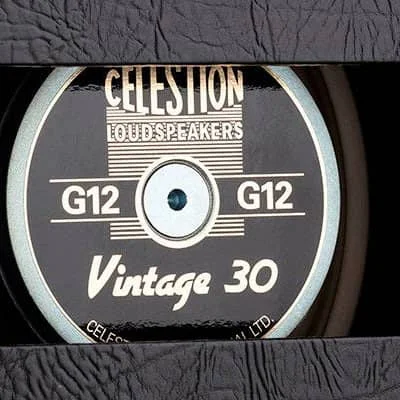
Speakers for Electric Guitar Amp (Buying GUIDE). Sizes, Types, Sensitivity and Popular Models: Eminence, Celestion, Jensen.
The speaker is one of the most important parts of a guitar amplifier, as it is the component responsible for transforming electrical signal into audio. A suitable speaker change can improve the sound of our amplifier, increase the volume of the device depending on its sensitivity, or even allow us to tailor the sound to our musical tastes.
It would also be a very simple improvement to make, as we would simply have to remove the old speaker and connect the new one. However, we need to be aware of certain guidelines before making a purchase, as there are many different models, magnet types, sensitivities, impedances, powers, and sizes available.
Speakers for Guitar Amp: SIZES
I will begin by specifying the most commonly used speaker sizes in guitar amplifiers. Small amplifiers usually have 8-inch speakers, as this size is sufficient for a device designed to play sound in small rooms, such as those found in any typical home.
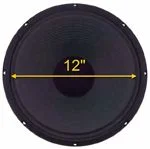
But in general, the most commonly used sizes are 10 and 12 inches. The 12-inch speaker is particularly recommended for combos and guitar amplifier cabinets. This size provides a fuller sound and guarantees good low frequencies. However, for a 4-speaker cabinet, the 4X10 configuration, with four 10-inch speakers, is also an interesting option.
Speakers for Guitar Amp: MAGNETS
Let’s move on to the type of magnet used in speakers. As with electromagnetic guitar pickups, there are two types of magnets: alnico magnets and ceramic magnets (also called ferrite magnets).
Ferrite ceramic magnets are powerful magnets that do not lose their magnetic properties over time, or if they do, it is barely noticeable, but they are somewhat heavy for transport.
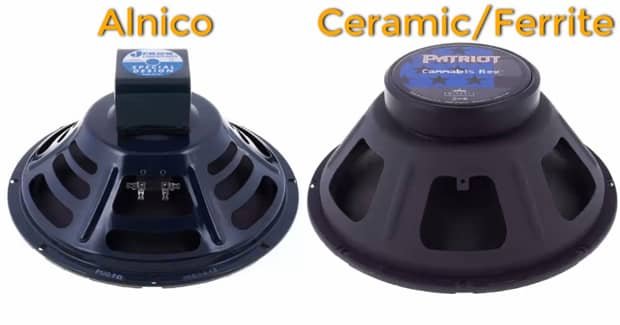
On the other hand, alnico magnet speakers are not as heavy, but over time they can lose some of their properties, resulting in a sound that is more purely vintage or traditional. Nevertheless, nowadays, the most commonly used magnets in guitar amplifier speakers are ferrite ceramic magnets.
Speaker Power
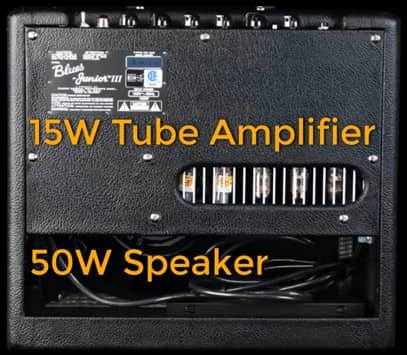
As for the power of speakers for guitar amplifiers, it is advisable that this greatly exceeds the power of the amplifier. For example, tube amplifiers between 5 and 15W normally have a speaker with a power of between 40 and 60W, with 50W being the standard.
The most advisable thing would be to maintain the power of the loudspeaker that was fitted with the standard amplifier. It is logical to assume that this is the best option, as it was determined during the manufacturing process.
Speakers for Guitar Amp: Sensitivity
Speaker sensitivity is measured in decibels (dB), and values typically range from 90 to 100 dB. These values indicate whether a speaker is low or high sensitivity. A speaker with a sensitivity of 90 dB would be a low-sensitivity speaker, and a speaker with 100 dB would be a high-sensitivity speaker.
Consequently, the same amplifier will sound louder with a high-sensitivity speaker than with a lower-sensitivity one. In this way, we can adjust the amplifier volume to suit its intended use.
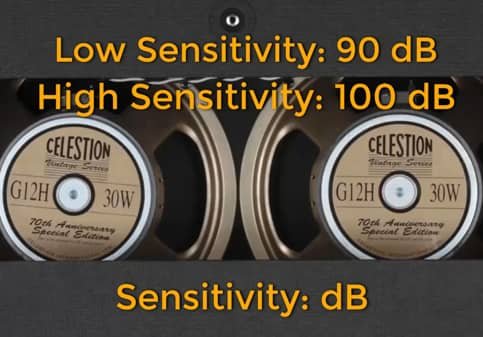
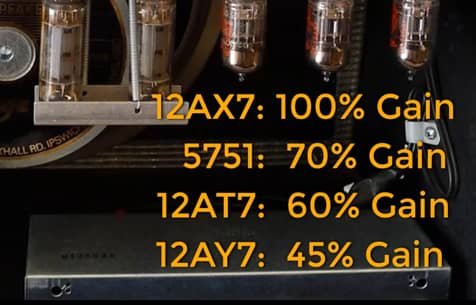
For example, if we are only going to use a 15W tube amplifier to play at home, we may be interested in a low-sensitivity speaker. On the other hand, for use in small concerts, it would be interesting to set up a high-sensitivity one, in order to have more overall volume, and also more volume in its clean range or headroom.
Conversely, a speaker with low sensitivity will cause the amplifier to sound weaker, requiring us to turn up the volume a little more, which will result in distortion.
In any case, all of this can also be adjusted depending on the type of tubes we install in our amplifier.
It often happens that we buy an amplifier that is too powerful for our home. In this case, we can solve the problem to a large extent by changing the speaker and using the right tubes (image above right).
Speakers for Guitar Amp: Impedance
When it comes to the most common impedances, we have 4, 8, and 16 ohm speakers. The differences in sound between different impedances are negligible or barely perceptible. The different impedances are used to adapt the speaker to the output of our amplifier or to the configuration of a cabinet.
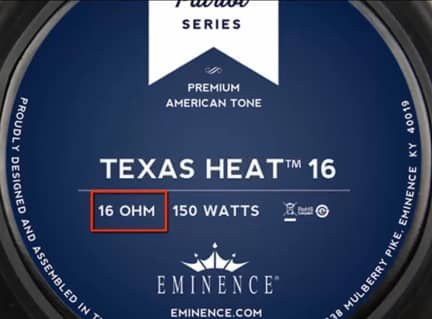
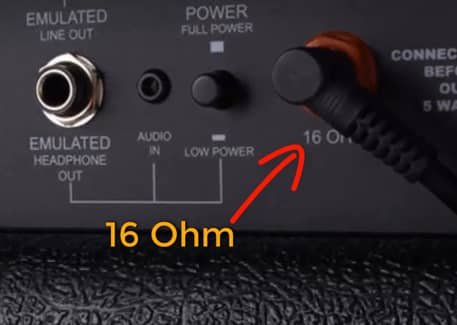
For example: if we have an amplifier with a 16-ohm output, we will have to connect a 16-ohm speaker to it, and if it is 8 ohms, then an 8-ohm speaker.
When purchasing a cabinet for our amplifier, we must provide the seller with sufficient information so that they can advise us appropriately based on the power, characteristics, impedances, and options best suited to our amplifier. This way, we can hold the seller accountable in the event of any problems.
We must be especially careful with impedances, as it is not enough to simply connect the first cabinet we find.
If we use a cabinet with higher impedance, the tubes will overheat, with the possibility of a short circuit. And if they have lower impedance, they can damage the amplifier transformer or the tube sockets. Transistor amplifiers can also malfunction if we do not respect the impedances.
We must also be very careful not to connect a tube amplifier without having a speaker connected, as this can burn out the amplifier’s transformer. And never disconnect the speaker from the amplifier while it is in operation. We should never tamper with any connected electronic device, let alone a tube amplifier. These devices store strong electrical charges in their capacitors and can give us a nasty shock.
Safety
One thing to bear in mind in terms of safety is to connect the amplifier to a grounded socket to prevent possible electric shocks and also reduce noise from the device.
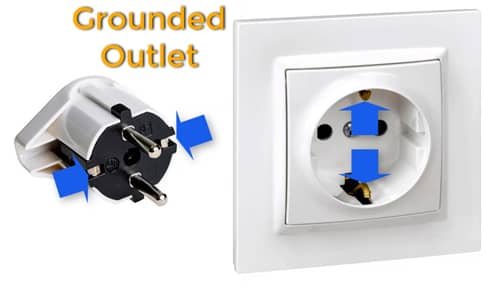
If there is no grounded outlet nearby, we will have to use a grounded power strip to reach the appropriate outlet. If the extension cord is not grounded, the ground circuit will be cut off, and we will have achieved nothing.
Best Speakers for Guitar Amplifiers
Among the most popular guitar amplifier speakers is the Jensen C12N Ceramic Vintage, with 50 watts of power and a high sensitivity of 98.4 decibels. This speaker is recommended for medium-gain amplifiers due to its good clean and slightly distorted sounds. Some may find it too sharp, but this will give us more presence when playing with a band, and we will achieve more defined distortions. In any case, like any speaker, it will improve after some time of use.
The Jensen P12Q Alnico Vintage has similar traditional features to the previous model, but it has an alnico magnet and is slightly more expensive.
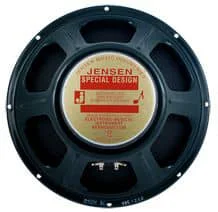
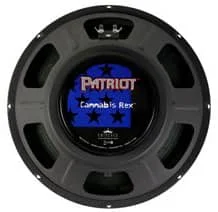
Other very popular speakers are the Eminence Patriot series, such as the Cannabis Rex. The Cannabis has warmer tones than the Jensen, while maintaining very high sensitivity, allowing us to get the most out of the amplifier’s power (101.8 dB).
But when it comes to popularity, I don’t think there’s a more popular speaker than the Celestion Vintage 30.
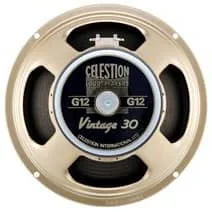
With a warm and versatile tone, it offers high efficiency at 100 dB. One of the most widely used speakers among rock musicians such as Slash, John Petrucci, and Carlos Santana.