
Different Types of PREAMP TUBES for Electric Guitar Amplifiers: 12AX7 – 5751 – 12AY7. MOST POPULAR BRANDS (Buying Guide).
Our tube amplifier has two types of tubes: preamp tubes and power tubes. The purpose of these tubes is to amplify the low signal coming from our guitar to obtain a much more powerful signal that can drive the speaker or speakers.
By changing the preamp tubes, we can easily improve or shape the sound of our amplifier. When installing preamp valves, no adjustments are necessary on our amplifier (bias). It is simply a matter of removing some tubes and replacing them with others of a different type. However, we must be aware of certain guidelines, depending on their position and each type of vacuum tube, for example.
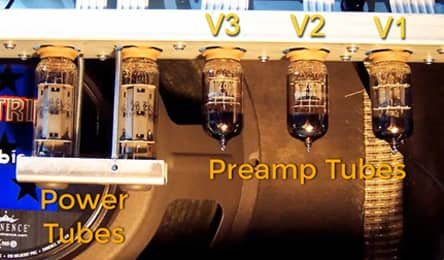
PREAMP TUBES for Guitar Amplifiers: V1 – V2 – V3
The preamp valves are named according to their position as V1, V2, V3, etc., starting from the valve that receives the signal. This first valve is usually the one located after the guitar connection input, and V2 and V3 are located in the direction of the power tubes. In the case of the image above, this would be from right to left.
Although the number of preamp valves an amplifier can have is indeterminate, it is very common for them to have three. This is the case with the Fender Blues Junior, Bugera V22, Laney Cub 12R, Marshall DSL5C, and Vox AC15. For the explanations, we will use an amplifier with three preamp tubes, as shown in the images: the Fender Blues Junior.
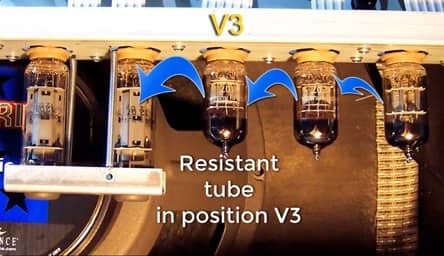
Preamp tubes amplify the signal repeatedly as it passes from one valve to another. For this reason, it is advisable to use a resistant or durable valve in position V3, as this valve receives a signal that is already quite amplified. Consequently, this tube can burn out if we use an unreliable one.
Attenuate Noise from PREAMP TUBES for Guitar Amplifiers
Similarly, if we place a low-quality valve or one with a slight defect in position V1, that defect, such as feedback or some type of noise, will be amplified by the other valves, multiplying the problem. This defect can be attenuated or increased, depending on the situation in which the valve causing the problem is located.
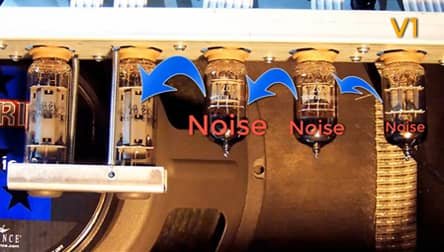
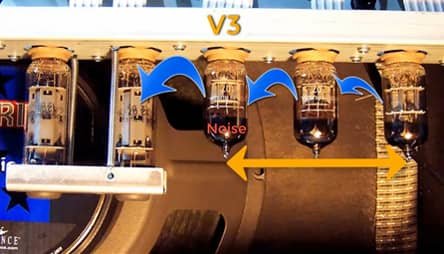
If the valve causing the problem is in position V1, the other valves will amplify the defect. But if we put that valve in position V3, the noise will be greatly attenuated as it will not be amplified by any further stages of the preamplifier. If we have this problem, we can swap the positions of the tubes to see the results, which may significantly improve the defect.
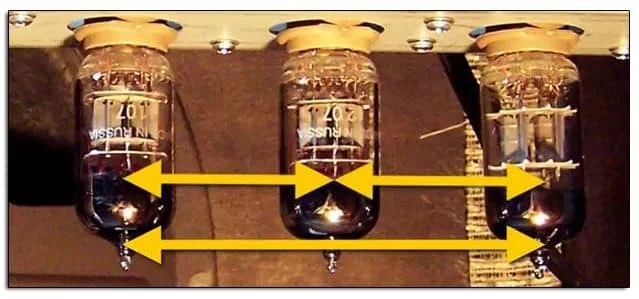
For this reason, it is advisable to install a good quality valve in position V1, regardless of its resistance, since this valve does the least work. We can also test which of the valves we have performs best in V1.
Preamp Tubes 12AX7
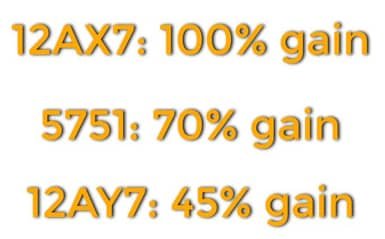
The valve model that amplifiers usually come with as standard is the 12AX7, known in Europe as the ECC83. This type of tube is a powerful model with 100% gain.
In positions V1 and V3, we can replace the 12AX7 with other valve models, but in V2 we must always keep the 12AX7 model.
The Tung-Sol 12AX7 valve is among the highest rated in the V2 position, but they are not recommended for V3 because they can fry. This tube offers a linear sound with low microphony, ideal for avoiding feedback. Feedback is that annoying beeping sound produced by an amplifier when the signal feeds back at high levels of gain or distortion.
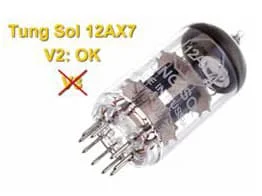
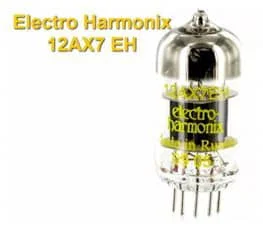
The Electro Harmonix 12AX7 EH is a bit cheaper than the previous one, but it is a great valve, and it also works very well in any position.
As mentioned above, for V1 or V3 positions we can install 12AX7 tubes. However, we can also use other valve models to adjust the overall gain and volume of the device. This allows us totailor the sound of the amplifier to its intended use or to our personal taste.
For example, if we want our amplifier to have a little more headroom and its volume to be a little lower, we can install some preamp tubes that are less powerful than the 12AX7 with 100% gain, replacing them with others with a lower percentage.
The 5751, for example, has 70% gain, and the 12AY7 only 45%. These percentages would be the standard, but they may vary slightly depending on each brand.
Tubes 12AY7
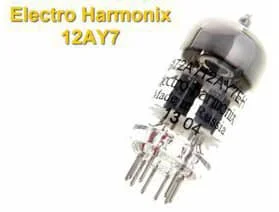
A 12AY7 commonly used in V1 or V3 is the Electro Harmonix 12AY7 model, with approximately half the gain of a 12AX7. This tube is widely used in Fender-style amplifiers and has a very good clean sound and overdrive.
Valves 5751
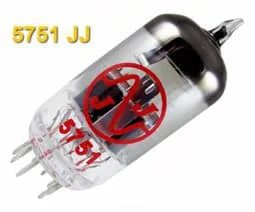
In the 5751 model, and with 30% less gain than the 12AX7, we have the 5751 JJ, with a very natural sound and low noise. Used in both positions to reduce the amplifier’s gain slightly.
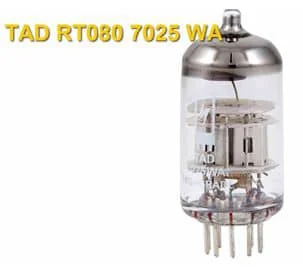
If we are not interested in lowering the gain, but want a low-noise tube for V1, we can use the TAD RT080 7025 WA. This model offers a great clean sound, as well as high gain.
In general, valves with small plates have less microphony or feedback than those with larger plates. For example, in the 12AX7 Sovtek LPS, you can see the difference in size of the internal plates compared to the Electro Harmonix.
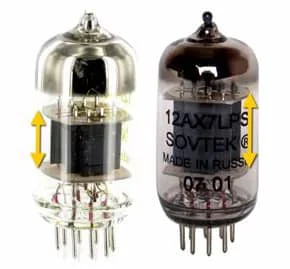
With this in mind, it would be better to place the Sovtek as V3. Furthermore, this particular tube performs very well in that position.
When to Replace the Preamp Tubes in an Guitar Amplifier
We should consider replacing the preamp tubes when we notice that the amplifier’s sound has deteriorated, with a lack of tone, strange noises, excessive feedback, loss of power, or if the device simply stops working. It can also be detected at a glance if the silver part of the tube changes color.
Although preamp tubes can last for years and years depending on the hours of use, the power at which we operate, or how we treat the amplifier. But the standard life span of preamp tubes is 2,000 hours. So depending on use, we can calculate their durability.