
BASIC Guitar Pedals for Beginners: Which Effects Should You Buy First to Build Your Pedalboard?
Firstly, I would like to recommend the article titled “Effect Guitar Pedal Order and How to Use the Effects Loop“, which explains the correct placement of pedals. This would be useful if you already own some effects pedals.
When it comes to fundamental guitar effects pedals, some effects are indeed more essential or used more often than others. However, this depends on the musical genre you want to play and the personal taste of each guitarist.
Some people highlight the chorus effect as one of the most basic and essential, but personally, I almost never use it. Honestly, it’s not an effect you use all the time.
Take Kirk Hammett from Metallica, for example. The wah-wah pedal might be absolutely indispensable to him. On the other hand, I don’t usually use the wah-wah pedal continuously.
Some guitar players don’t use any effects, relying solely on the sounds they can achieve through their tube amplifier’s distortion levels. This allows them to produce clean tones ideal for genres like jazz, slightly distorted tones perfect for genres like the blues, and even heavily distorted tones using high-gain amplifiers.
Distortion: One of the Most Basic Guitar Pedals
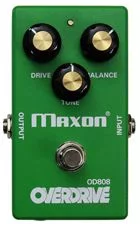
Overdriving a tube amplifier is one of the most fundamental ways for guitar players to achieve distortion. There are countless pedals dedicated to its different ranges and styles of distortion, offering an endless variety.
I personally use two overdrive pedals to control the saturation of the sound. This allows me to achieve a subtle blues-style boost with one overdrive set to minimum and intense hard rock-style firepower with both overdrives set to maximum. However, doing the latter will likely cause excessive feedback issues.
Like many people, I don’t enjoy spending the whole afternoon fiddling with buttons. So I set these two overdrive pedals to the middle setting. Depending on what I want to achieve, I turn on one or both.
However, both clean and distorted tones can sometimes sound flat and uninspiring. This is why we need to add depth to achieve a fuller sound.
Reverb Effect: The Importance of Echo
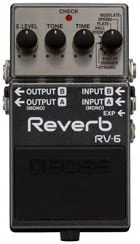
To add depth to our sound, we need a reverb pedal. In my opinion, it is an essential effect and comes as standard on many amplifiers. In fact, I use it almost all the time, at different levels and in different ways, with both distorted and clean sounds. It’s just like the Compressor in that respect.
Compressor Pedal: A Basic Effect for Clean Sounds
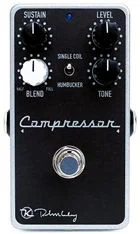
If you want to produce a wide range of sounds, from clean to heavily distorted, the compressor pedal is another essential piece of equipment.
To achieve optimal clean tones with body and decent sustain, for example, you’ll need a compressor pedal. By using just a reverb effect and a compressor pedal, you can achieve the classic, full-bodied, sweet and balanced single-coil tones typical of songs by artists such as Mark Knopfler and John Mayer.
Hall is the most suitable type of reverb for this kind of sound. It’s a very natural effect, yet it has a clear presence and depth. The hall reverb alone fills the entire space, creating a full-bodied sound.
A compressor pedal is essential for achieving clean tones, but it can also add more punch and sustain to distorted sounds.
However, distortion adds compression to our sound by itself. If the distortion from our pedals is very high, the compression will be too. In this case, adding more compression wouldn’t make much sense.
Using a compressor will make the sound of our single-coil pickups thicker. This effect is widely used on guitar models like the Stratocaster or Telecaster. Although it can be used with any guitar model, it may make the sound of humbucker pickups, such as those found on Les Paul-style guitars, overly thick, especially the sound of the neck pickup.
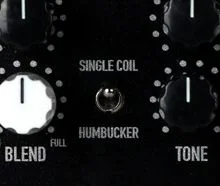
For this reason, some compressors offer different compression modes depending on the type of pickups used. Others have a sustain mode that brightens the sound and increases the dynamic range.
BASIC Guitar Pedals: Delay
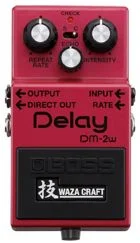
Another effect widely used to add depth to sound, much like reverb but in a different way, is delay. It is also found among basic guitar pedals. I usually apply these effects separately, but when I use them together, I opt for subtle settings. This stops the guitar sound from sounding too synthetic.
Although these depth effects are widely used, they can sometimes be counterproductive. Take the Red Hot Chili Peppers song “Can’t Stop”, for example. For this song, John Frusciante requires a completely dry sound, free from any echo, whether from reverb or delay. This dry sound stops a “sound ball” from forming when Frusciante repeatedly cuts off each note. However, effects such as overdrive and compression are useful for playing this song optimally.
In short, this covers all the essential information you need about the effects pedals that can produce a wide range of sounds. You’ll have everything you need to achieve a great guitar sound, which is ultimately what matters most.
For example, if a song uses a chorus effect and we don’t have the right pedal, we can use reverb or a delay effect instead.
As an alternative, we could simply omit effects that are usually used alongside distortion, such as the wah-wah, flanger and phaser. After all, distortion usually forms the basis of the sound.