
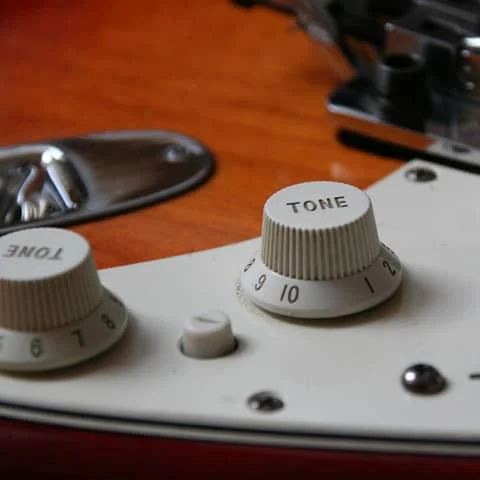
How to Setting the TONE of Electric Guitar and Amplifier. The influence of the stay and other instruments on equalization.
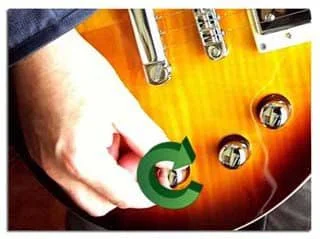
To setting the tone of your guitar and amplifier, we will start with the guitar’s tone knob at maximum and the amplifier’s equalisation controls at centre, to test the resulting sound.
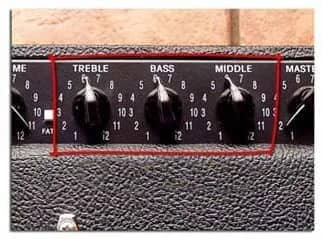
There are many factors that can influence the tone of each amplifier, such as the brand and speaker type, for example.
Once you’ve heard the resulting sound, you can begin setting the amp’s tone to your personal taste. To know if you’re doing it right, you just have to trust your ears. Even if they don’t seem like it, they’re smarter than you think. Our ears will complain if the sound is too sharp, and they will lose interest in what we are playing when the sound is too muffled.
Self-confidence is a great asset in everything you do, and playing the guitar is no exception. So, being clear about what you want and what you don’t want is vital. In any case, there are guidelines you should know.
How to Setting Guitar and Amplifier Tone
Guitar tone controls are not usually very progressive. Let’s say that they basically have three adjustment positions. With the potentiometer set to low, the instrument would sound with practically no tone at all; in the middle range, it would begin to have some tone; and at maximum tone. It also depends on each guitar and the quality of its components, such as the potentiometers.
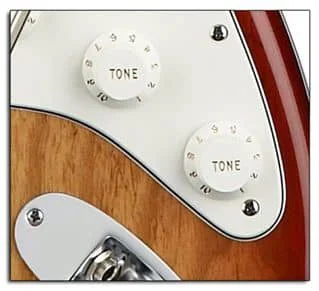
When playing alone at home, it wouldn’t hurt to set the guitar’s tone control to maximum and then setting the amplifier’s equaliser. If the sound is a bit shrill, you can lower the guitar’s tone a little, but I wouldn’t lower it too much.
Since there is no progression in this control, we may lose tone if we turn it down too much. In that case, we would have to correct the tone again, and no one likes to spend the afternoon moving controls of the guitar. What we all want is to play the strings.
The amp’s tone controls, or equalizer, are very sensitive. Therefore, with these controls, we can modify the tone much more accurately. Consequently, we can setting the tone of the amp’s according to the needs of each situation. For example, if we’re playing alone, accompanied by bass and drums, or to adapt to a specific musical genre.
How to Setting Guitar and Amplifier TONE with Accompaniment
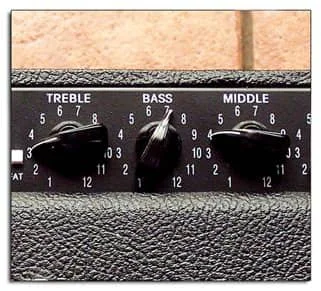
If we’re playing a piece of music solely on our guitar, it’s normal to have the bass control above the mid and treble controls. Don’t be lazy about lowering the treble and midrange to cut these frequencies, which would become too present, to the detriment of the bass.
Setting TONE by Playing with Accompaniment
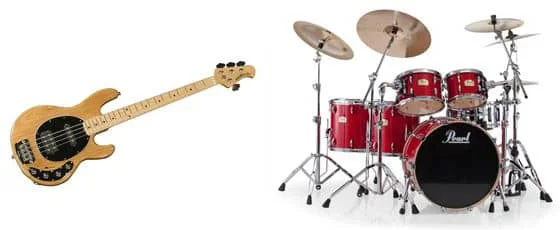
Another thing would be to play accompanied by bass and drums. These instruments provide a generous amount of low frequencies, drowning out the sound of our guitar in the process, if we have the equalizer set the same way we would for listening to ourselves alone. In this case, we would have to start boosting the mid and high frequencies to give us more presence.
As you can see, equalisation depends on many factors and must be adapted to each situation, including the room we are in.
For example: if we play in our small rehearsal space with a certain equalisation, and on Friday we have a gig in a bar, be prepared to modify the amplifier’s equaliser once you have set up in that venue. For this reason, it is very important to rehearse a little in that particular venue. This way, we can adjust the equalizers so that we don’t get an unpleasant surprise when playing in front of an audience.
Amplifier Contour Control
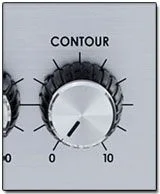
Some amplifiers feature a Contour Control. This control modifies the equalization curve and acts on all three classic frequencies simultaneously (bass, mid and treble).
With the contour control at its lowest setting, the EQ curve would be shaped like a “V.” There would be a lot of bass, little midrange, and a lot of treble.
At the middle, the EQ curve is a horizontal line. The bass, mid and treble would be at the halfway point, or 50%.
And at its highest setting, the EQ curve resembles an inverted “V.” There would be little bass, a lot of midrange, and little treble.
Is there any FORMULA for Equalization?
Definitely, there’s no concrete formula for equalization, as our tone can be affected by different circumstances. So, setting the tone of your guitar or amp is a matter of confidence in the tone you want to achieve, depending on the circumstances.
So don’t waste time searching the internet for EQ settings, as the good ones have different EQs depending on the track in question. The image below shows guitarist Mark Knopfler’s effects and EQ settings during one of his final tours with Dire Straits.
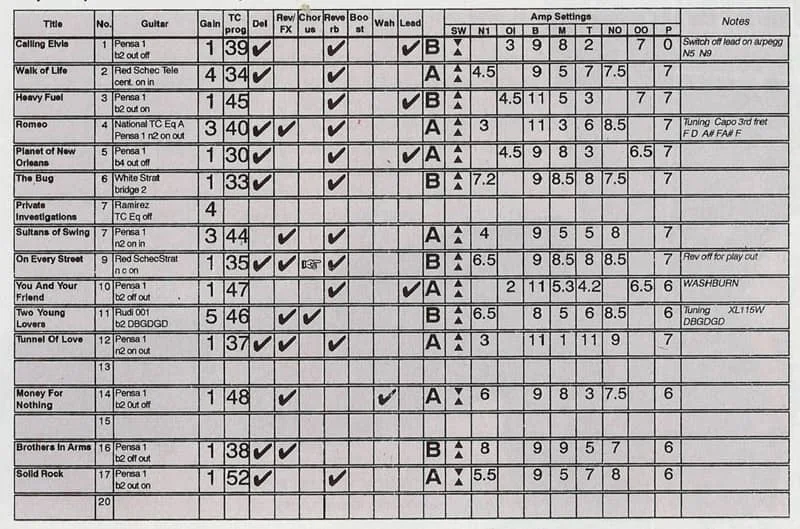
As you can see, each track has its own equalization. It’s nice to see it as a curiosity, but it’s not useful for us. Unless we’re playing in a football stadium, with Mark Knopfler’s guitars and his amps.
How to Setting Guitar GAIN: Distortion
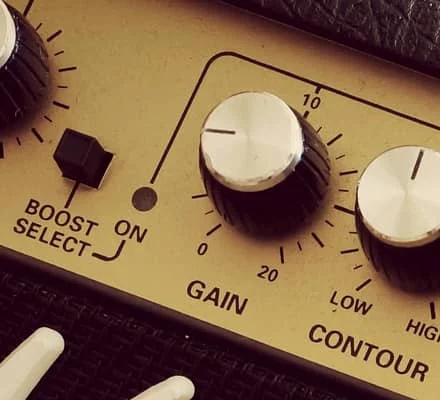
Click on the image above to learn how to setting the GAIN or DISTORTION of your electric guitar and amplifier. Learn how to use the controls on your electric guitar and amplifier, which handle this function, and how to use the MASTER VOLUME.