
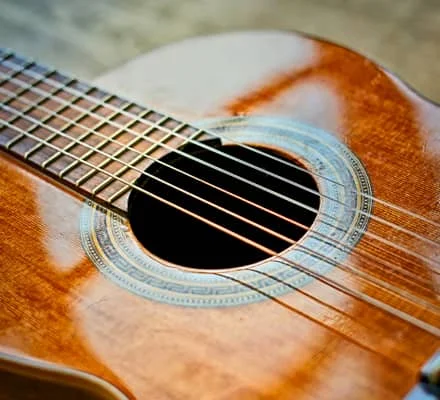
Spanish Guitar CHARACTERISTICS: History, Strings, Sizes and their DIFFERENCES with respect to the Flamenco Guitar and the Acoustic Guitar.
Spanish Guitar History
The history of the instrument generally known as the guitar would begin with the classical guitar, and it is the mother of all the other variations, evolutions or types of guitars developed to this day.
This type of guitar is usually the model that most fans choose to play their first chords, benefiting from the low tension and softness of its strings. Who hasn’t started playing the guitar with one of these, or even has a guitar of this style even if their musical orientation is towards more electric styles.
An instrument that is part of the compositions of many guitarists, not exactly famous for using the classical guitar like Mark Knopfler, Carlos Santana, or Tom Morello. Although we have other examples, such as Willie Nelson, who simply refuses to give up his classic guitar, no matter how battered it may be after half a century together.
It is generally known as the Spanish Guitar, due to the importance that this country had in the definitive development of the guitar as a solo concert instrument.
Fernando Sor

It was Fernando Sor who popularised compositions with this instrument at the beginning of the 19th century, known as the “Beethoven of the guitar”, and was the author of an extensive method that documented his technique and style.
In general, guitars made in other European countries at that time had their own regional characteristics. They were well-built instruments, but they could not compare with the tone and projection of Spanish guitars.
European luthiers were amazed by the tone and quality of the guitars played by Fernando Sor. For this reason, manufacturers in other countries began to adopt Spanish construction and design methods in their own workshops, which were then described as Spanish-style guitars.
Antonio de Torres Jurado

However, it was the Spanish luthier Antonio de Torres Jurado who, in the mid-19th century, achieved the perfect formula and became the most important figure in the history of guitar design and construction, as the instrument is now manufactured almost exactly according to his style.
Antonio designed what is undoubtedly the first classical concert guitar, based on a larger and deeper body, with a soundboard of variable thickness, and a renewed system of Bracing.
Antonio de Torres was also responsible for clearly establishing the differences in design and construction between the classical guitar and the flamenco guitar. Each design adopts its own characteristics, which I will discuss later.
Andrés Segovia
It is impossible to talk about the development of the classical guitar without mentioning Andrés Segovia, the instrumentalist responsible for the acceptance of the Spanish guitar as a concert instrument for classical music.
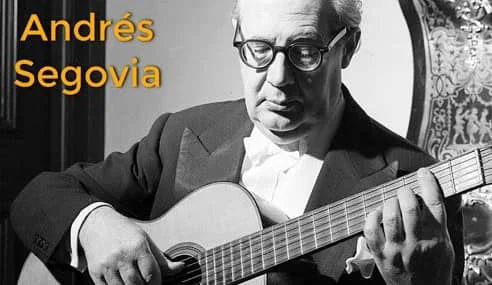
So it is no coincidence that the classical concert guitar is called the Spanish guitar. It is a name adopted on its own indisputable merits.
Woods, Strings and Sizes of the Spanish Guitar
Woods
The most commonly used woods in the manufacture of classical guitars are:
- Neck: mahogany or cedar.
- Fingerboard and bridge: rosewood or ebony.
- Soundboard: cedar or spruc.
- Sides and Back: rosewood, sapele or mahogany.
Strings
Classical guitar strings used to be made from animal gut, but today they have fallen into disuse due to the better performance and lower price offered by nylon. This material is the standard in the manufacture of strings for Spanish guitars. Although the three lowest strings have bronze or nickel wound.
Nowadays, we can find other materials used in the manufacture of classical guitar strings, such as carbon fibre, titanium, or sets that use both materials. You can also find strings coated with polymers.
All these different types can be found in different gauges depending on the hardness of the manufacturing materials. These conditions establish the parameters for the hardness and tension of the strings. For example, carbon fiber would be the material that provides the greatest tension, and allows us to place thinner or strings on our guitar.
In general, regardless of calibre or manufacturing material, strings are classified as low tension, medium tension or high tension.
As a result, the string will provide a brighter, volume and more attack sound as we increase the tension level. The drawback is that the instrument would be more complex to master.
Tuning Pegs
This type of guitar usually has machine heads with a threaded spindle, similar to those used on acoustic guitars. The difference that the machine heads of a classical guitar are assembled in a set of three units. The pegs of an acoustic guitar are made in separate units, and are usually covered with a cap. But the system is exactly the same.
Traditionally, tuning machines have been made of ivory and bone, but more recently they have been made of synthetic materials. Over time, this type of pegs can generate squeaks or poor sliding with the wood. The solution to avoid these problems may be to use talcum powder on the lathe joints to improve their sliding.
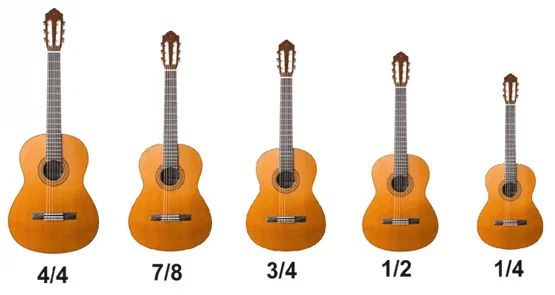
Spanish Guitar Sizes
Classical guitar sizes are geared towards the age of the player:
- The smallest guitars would be the 1/4 size ones, aimed at ages 5 to 6 years.
- The 1/2 size guitars would be for ages 7 to 8 years.
- The 3/4 and 7/8 ones for ages 8 to 10 years.
- And the 4/4 one for ages 10 and up.
Differences between the Spanish and Acoustic Guitar
The classical guitar has a wide, thick neck and a completely flat or infinite radius fingerboard. As opposed to the narrow necks and more curved fingerboards of a steel-string acoustic guitar.
The neck and body of a classical guitar meet at the 12th fret, and the join on an acoustic guitar is at the 14th fret.

Furthermore, the acoustic guitar has a more voluminous body, unlike the smaller and lighter body of the Spanish guitar. Acoustic guitars need to incorporate greater reinforcement in the bridge due to the increased tension that metal strings exert on the tailpiece. This prevents the guitar from warping.
Differences between Spanish and Flamenco Guitar
One of the most widely used variants of the Spanish guitar worldwide is the flamenco guitar. Although at first glance they may appear practically identical, the flamenco guitar has some distinctive features. Such as some variations in the woods, a somewhat narrower body, and a lower string action than the Spanish guitar.
These features make it a very comfortable guitar, making it the preferred choice for many players.


The internal design of the flamenco guitar also includes some variations. Some models have pickguards that protect the wood from the strumming and hitting that is so common in flamenco music. The flamenco guitar even has specific strings designed for this musical genre.
The sound of the flamenco guitar is somewhat rougher due to the fret buzz produced by the lower action of the strings. Its tone is brighter, more percussive and lower in volume, due to its narrower body. This makes it much better suited to the demands of flamenco music, although it can also be used in other musical genres.
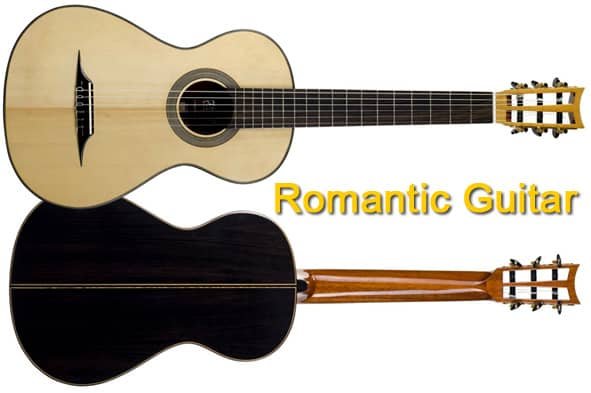
Romantic Guitar
Another variation of the Spanish guitar is the romantic guitar. This would be the retro version, predecessor of the classical guitar, in the style of the guitars used by Fernando Sor. With this model we obtain the typical sound of romanticism.
The classical guitar has also been unable to escape the use of technology. On the market we can find models with integrated amplification units, known as electro-classical guitars.
Some models are modified with a cutaway to facilitate access to the last frets of the fingerboard. We also have narrow-body models optimised for amplification.
Finally, I would like to make an important recommendation. One concern for guitarists who use their fingers to play, is having nails that are too soft or brittle. To solve this problem, we can use Mavala nail hardener. It is the best nail hardener I have tried, and it works relatively quickly. In just a couple of weeks, we will notice that our nails are much harder.