
Types of Distortion Pedals for Electric Guitar and Features of the Most Legendary Models (GUIDE).
Although the first electric guitar amplifiers were designed to produce a clean sound, many guitarists sought to make their amplifiers distort as much as possible. Some even cracked their speakers to achieve this.
In response to this demand, Marshall developed an amplifier geared more towards distortion than clean sound. This amplifier went on to achieve immense popularity.
Later, technological advances made it possible to achieve those heavily saturated sounds by simply flicking a switch. Consequently, distortion pedals became widespread, and the effect became a staple of virtually all popular music genres.
This effect provides a wide range of pedal types and distortion levels.
Distortion Pedals: Overdrive
One of the milder options is an overdrive pedal. These pedals provide gentle, controlled distortion to add intensity to the sound, while also increasing sustain and boosting harmonics. If you’d like to find out more, I’ve included a link at the end of this paragraph about overdrive pedals.
High-Gain Sound
At the other end of the spectrum are high-gain pedals, which are perfect for heavier genres like metal (see the bottom of the page).
Standard Distortion
The pedals listed below lie between overdrive and metal pedals. These pedals produce a more compressed sound with a consequent reduction in dynamic range compared to an overdrive.
They also offer greater sustain and a more pronounced bass presence, enhancing the attack of the pick when it strikes the string. These features are highly valued by metal rhythm guitarists.
I’ll show you some of the most popular and legendary distortion pedals. These have long been used by professionals and are generally quite affordable.
Types of Pedals: STANDARD DISTORTION
Boss DS-2 Turbo Distortion: A Distortion Legend
The Boss DS-2 Turbo Distortion pedal is arguably one of the most popular models around. Renowned artists such as John Frusciante, Kurt Cobain, Steve Vai and Prince have used this pedal. The Boss DS-2 features standard volume, tone and gain controls, as well as a control offering two distortion modes.
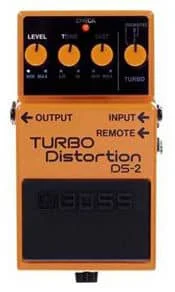
In Mode I, the sound is distorted in a way that is similar to overdrive. Mode II boosts the mid-range, giving the sound a slightly more aggressive edge. It costs around $110.
Pro Co Rat: A Classic Among Distortion Pedals
The Pro Co Rat is a legendary distortion pedal. It has been used by countless guitarists, including Jeff Beck, David Gilmour and James Hetfield.
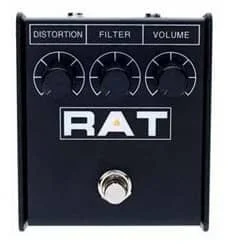
This simple, robust and versatile pedal offers a distortion effect that lies halfway between powerful overdrive and smooth fuzz. Its price is around $90.
Types of Pedals: FUZZ DISTORTION
Fuzz distortion is one of the different types of distortion pedal. This type of effect provides a powerful bass response and less shrill treble. The distortion is also less defined and linear than standard distortion.
This is its defining feature, as fuzz produces a grainy distortion similar to the sound made when a speaker is cut with a blade.
Electro Harmonix Big Muff: Infinity Sustain
The Electro-Harmonix Big Muff Pi is a legendary fuzz distortion pedal. It has been manufactured since the late 1960s and has been used by renowned guitarists such as Frank Zappa, Carlos Santana, Jimi Hendrix and Jack White.
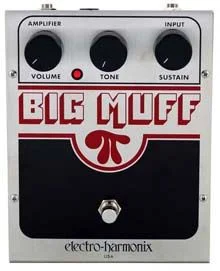
The Big Muff is characterised by its high gain at the maximum setting, virtually infinite sustain and a sweet, creamy tone. This pedal it offers an extended bass and treble response, along with a distinctive dip in the mid-frequency range. Unlike other pedals, which have passive tone control that simply filters out high frequencies, this pedal has active tone control.
This characteristic feature provides enormous tonal versatility by radically altering the distortion tone from dull and low-pitched to bright and thin.
While this pedal offers great tonal versatility, the same cannot be said for the distortion. Even when the control is set to its minimum setting, a certain amount of gain is still produced.
The Big Muff is not very responsive to the guitar’s controls. It is impossible to achieve a reasonably clean sound by turning down the guitar’s volume. It costs between $100.
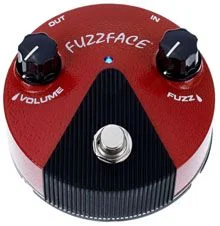
Dunlop Dallas Arbiter Fuzz Face
Another legendary pedal is the Dunlop Dallas Arbiter Fuzz Face. Renowned guitar players such as Stevie Ray Vaughan, Eric Clapton, Pete Townshend and Eric Johnson have used this pedal.
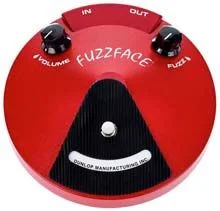
While the Fuzz Face does not offer the same level of punch as the Big Muff, it is possible to control its distortion more effectively using the guitar’s own controls. However, it can only be powered by a battery.
Another option is the smaller Dunlop Germanium Fuzz Face Mini. This model can be powered by either a battery or a mains adaptor. However, it is cheaper than the previous model, with an estimated price of around $160.
Types of Pedals: DISTORTION for Playing METAL
Another type of distortion pedal is one designed specifically for metal music. These pedals provide high-gain distortion and typically include middle, bass and treble EQ controls.
By controlling these frequencies, we can produce a sound similar to that of our favourite artists or create our own unique sound using the distortion’s EQ to achieve an endless variety of sounds. Consequently, we can take the instrument’s tone to the extreme.
Although there are plenty of pedals of this type, in this page I’ll show you the ones that generally receive the highest ratings in terms of price, sound quality and features. Some of these pedals are unpopular simply because we lack the patience to interact with them smoothly.
Boss Metal Zone MT-2
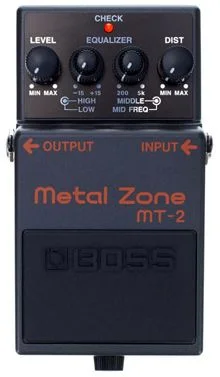
Let’s start with a classic among metal guitar pedals: the Boss MT-2 Metal Zone. This particular pedal is one of the most controversial. While some people hate it, many more love it.
This unit features dual-gain circuits that produce two-stage distortion and generate a high level of distortion.
In addition to the bass and treble controls, it has dual controls for the mid-range frequencies:
- Mid Fred: Use the Mid Freq control to adjust the specific mid-range frequency you want. This control becomes more pronounced from the halfway point onwards, enabling you to darken the pedal’s tone if the guitar’s tone is too shrill.
- Middle: Use the middle control to adjust the intensity of the mid-range frequency band.
The EQ controls on the Boss MT-2 are highly sensitive, so it takes time to familiarise yourself with how each one responds. Once you’ve achieved the approximate tone, you can make very subtle adjustments to fine-tune it, thanks to the wide range covered by the EQ bands.
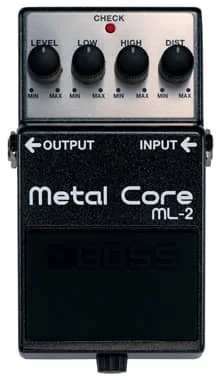
Boss ML-2 Metal Core
The Boss ML-2 Metal Core is easier to set up. With just two controls for bass and treble boost, as well as volume and distortion level controls, it’s simple to use. If you’re after extreme distortion and powerful bass, this could be the pedal for you!
MXR M116 Fullbore Metal
Priced similarly to previous models, the MXR M116 Fullbore Metal will also require some time to familiarise yourself with its EQ settings. This pedal has a noise gate which can be adjusted using the Gate button located inside the battery compartment.
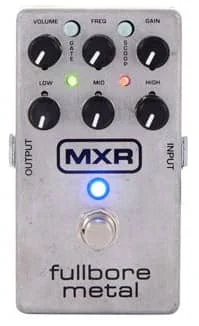
Similar to the Boss Metal Zone, the “Scoop” mid-sweep knob offers two controls for adjusting mid-range frequencies and boosting the bass and treble.
Electro Harmonix Metal Muff
When it comes to metal distortion, the Electro-Harmonix Metal Muff is legendary. Offering one of the most authentic tube amp saturations in pedal form, it costs around $110. Considering that this pedal features a three-band EQ with a fairly wide frequency range and an adjustable treble booster via the Top Boost control, this is a very reasonable price.
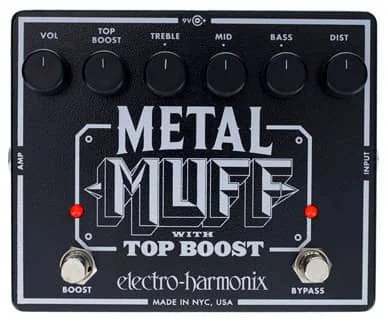
The Nano Metal Muff Distortion pedal is housed in a more compact enclosure and is priced at $85. Although this pedal does not feature a treble booster, it does incorporate a noise gate, which some people may find more interesting. It’s more compact and cheaper, and it also has a noise gate.
Note: Using these pedals with poor-quality power supplies can generate a lot of noise. To achieve good distortion with minimal noise, you’ll need power supplies with isolated outputs. Using a noise gate would also be beneficial.