
Fender Amplifiers (Guide): Discover Their LEGENDARY Series and MODERN Models. Series: Twin, Twin Reverb, Bassman, Deluxe Reverb, Hot Rod…
As many of you will know, Fender is one of the world’s most renowned brands for electric guitars and basses. It is also renowned for producing amplifiers for these instruments, and has played a significant role in the development of many musical genres.
This page showcases a variety of tube models, ranging from classic and traditional designs to modern modelling and solid-state versions.
FENDER Twin Amplifiers
As we know, an electric guitar cannot function properly without a purpose-built amplifier. So, after designing the Telecaster guitar, Fender promptly launched the Fender Twin amplifier, which was designed specifically for that instrument.
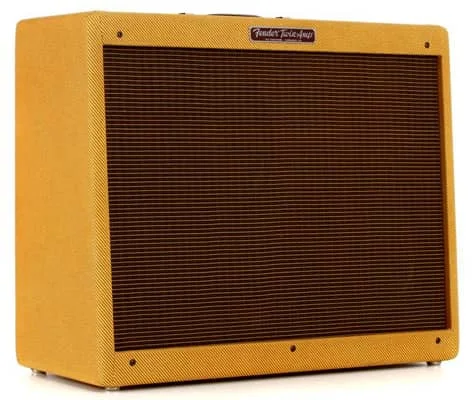
This is one of the most well-known and widely used lines of electric guitar amplifiers in history. The Fender Twin has played a pivotal role in the development of music in California, particularly in genres such as blues and rock. It has been used by legendary guitarists such as Eric Clapton, Keith Richards, Jack White and John Frusciante. However, this amplifier has also been used for genres requiring a distinctive sound, such as jazz and country.
Fender Bassman
After releasing its Precision Bass in 1952, Fender created the Bassman amplifier.
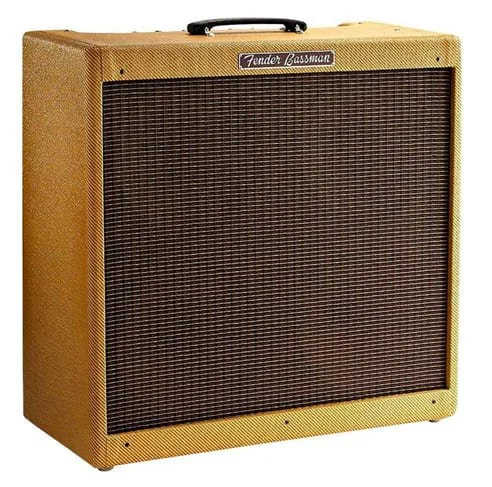
Although this amplifier was initially designed for use with the electric bass guitar, it has since been used with other instruments, including the electric guitar. Legendary artists such as Jeff Beck and Kurt Cobain have used it. Furthermore, the Fender Bassman was the ultimate amplifier. Its success inspired other brands, such as Marshall and Mesa Boogie, to develop high-gain amplifiers.
The Fender Bassman is still available today for both bassists and guitarists, although it costs around $2.200. This bulky stage amplifier has four 10-inch speakers and weighs 24 kilograms.
Fender Launches the Deluxe Reverb and Twin Reverb Amplifiers
In the mid-1960s, Fender released two of its most iconic guitar amps: the Deluxe Reverb and the Twin Reverb.
As for the current reissues of these models, I’d say that the ’65 Deluxe Reverb is essentially the little brother of the ’65 Twin Reverb. However, their prices aren’t that different. The Deluxe costs around $1.800, while the Twin Reverb is priced at around $2.200.
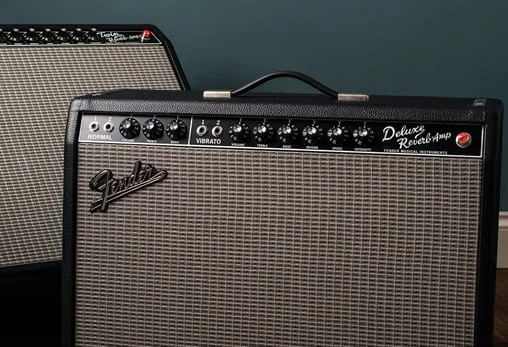
Don’t panic. As with guitars, items made in the United States tend to be expensive. I’ll show you some more affordable tube amps later on. I guarantee these amps can knock the fillings out of your teeth with a single, powerful guitar riff!
Okay. Returning to the topic at hand, the Fender ’65 Twin Reverb is widely regarded as one of the brand’s true masterpieces. Boasting an impressive 85W of power and two 12-inch speakers, it is easy to see why. This amplifier enables you to play at high volumes without introducing distortion.
We can also achieve a delicious crunch by using a good distortion pedal or simply by turning up the amp’s volume. That said, it would be much more convenient to use distortion pedals to control the saturation of this amp.
In short, this beast is clearly designed for professional musicians and performs best on stage.
Tone Master Series
As part of the Tone Master series, Fender has recently released transistorised versions of the Deluxe Reverb and Twin Reverb amps. They look exactly like the originals, but without the weight and maintenance issues of the classic versions.
The Fender Tone Master Deluxe Reverb is a 100W power amplifier designed to match the 22W tube power of the original model. It features a 12″ Jensen N-12K speaker with a neodymium magnet and is available for just under $1.200.
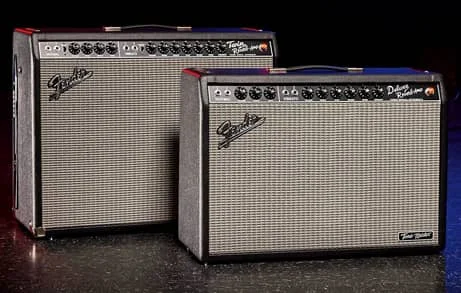
The Fender Tone Master Twin Reverb model has been designed to recreate the original’s distinctive high clean headroom. To achieve this, it delivers 200W of power, which is equivalent to the 85W of the tube version. It features two 12-inch Jensen N-12K speakers and is priced at around $1.400.
There is no need to be concerned about the power output of these two units, as both amplifiers feature a switch that progressively reduces the power output to 1 watt for the Tone Master Twin Reverb and 0.2 watt for the Tone Master Deluxe Reverb.
Fender Amplifiers:Hot Rod Series
Fender developed one of the most successful amplifier lines in terms of value for money in the 1990s, and the product is now in its fourth generation. This is the Hot Rod series. It is manufactured in Mexico to reduce production costs. But let’s be realistic: these are professional-grade amplifiers. While they are more affordable, they are certainly not cheap.
Fender Blues Junior: Among the Most Successful Models
The Fender Blues Junior is the most popular model in this renowned series of amplifiers. This compact yet fully featured tube amplifier boasts 15 watts of power, a 12-inch Celestion speaker and authentic classic spring reverb.
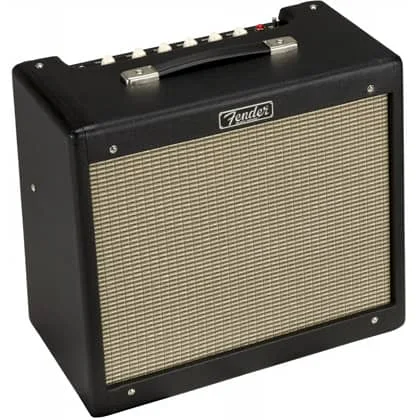
This amplifier produces an excellent clean tone and is ideal for use with effects pedals as it can handle the distortion they produce very well. This is a versatile amplifier that can produce a wide range of sounds, from mellow tones to the heaviest hard rock, when used with effects pedals.
At first glance, this amplifier might seem unremarkable due to its compact design, but when paired with a few effects pedals, it is literally a beast. It is used by top professionals such as John Mayer and Noel Gallagher from Oasis. Although it costs around $780, bear in mind that this is a one-time investment that will last a lifetime.
Fender Hot Rod Deluxe
If you require 40 watts of tube power, consider the Fender Hot Rod Deluxe. It has a 12-inch Celestion speaker and costs around $1.000.
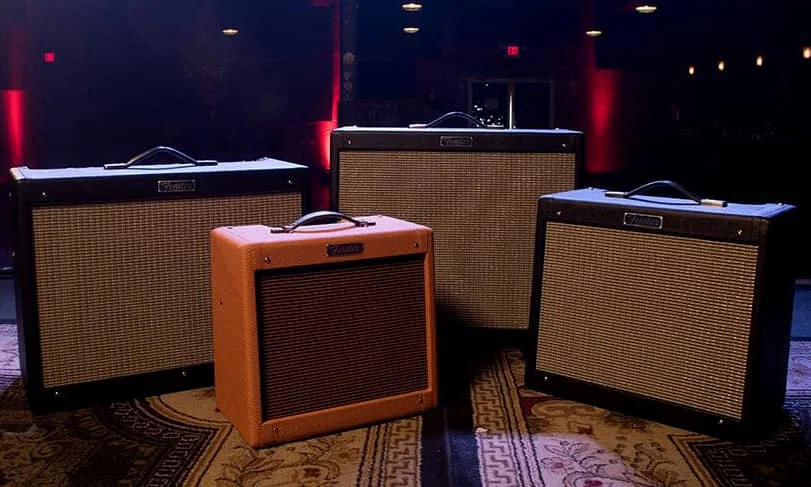
Another amplifier with similar features and a similar price point is the Fender Blues Deluxe Reissue, which is also one of the brand’s best sellers. It boasts an attractive tweed finish and a 12-inch Eminence speaker.
If you’re looking for a wider sound range, consider the Fender Hot Rod Deville 212 IV. It has two 12-inch Celestion speakers and 60 watts of power. While the 15-watt Blues Junior is impressive, this one is downright terrifying.
It usually costs around $1,200, and its users include Albert Hammond Jr., guitarist for The Strokes, and Robby Krieger of The Doors.
Super-Sonic and Princeton Series
Fender also offers other notable lines, such as the Super Sonic series and the highly regarded Princeton line, which is popular with studio musicians. However, Fender’s extensive catalogue of classic amplifiers is unbeatable.
Modeling Amplifiers
Fender doesn’t just offer high-end amplifiers; it caters for all market segments.
Fender Mustang LT25
If you’re looking for a modelling amplifier to practise with at home, for example, we have one of the best-selling models on the market: the Fender Mustang LT25.
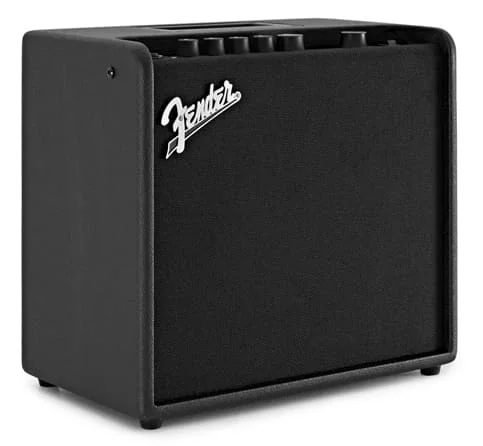
Priced at around $160, this amplifier offers excellent value for money. It features an elegant design, 25 watts of power, an 8-inch speaker, a headphone output, a tuner and a USB port for connecting to a computer and recording. This series offers the ultimate in convenience and versatility. These amplifiers have built-in digital effects and do not require the maintenance that tube amplifiers need.
The Mustang series includes various models with different power outputs. One of the most powerful is the transistor-based Fender Mustang GTX100 model, which has an output of up to 100 watts. It features a 12-inch speaker and is priced at around $500.
Fender Amplifiers: Champion Series
The Champion series comprises a range of transistor amplifiers with built-in effects. The least powerful model in this range is the Fender Champion 20, available for the modest price of $150. For those who don’t want to overcomplicate things, it’s a more affordable and simpler option than the Fender Mustang.
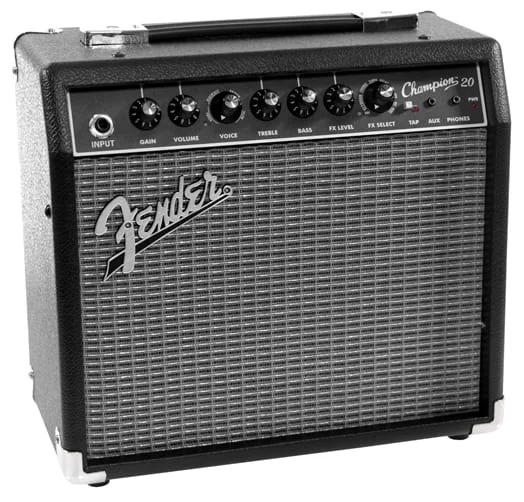
This series is also available in a range of power ratings. The most powerful version is the Champion 100, which delivers 100 watts through two 12-inch speakers and is priced at around $460.
While there are legendary guitar amplifier manufacturers, such as Marshall, and iconic guitar makers, such as Gibson, Fender offers both under a single brand. Its guitars and amplifiers are universally recognised.