
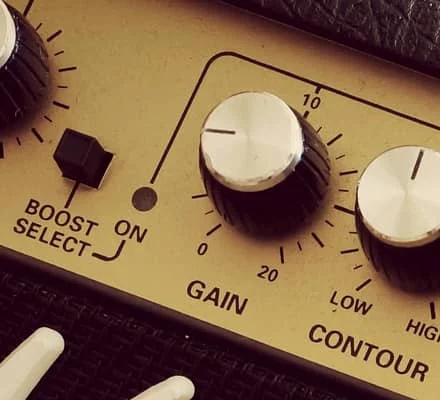
We can setting the gain or distortion of our guitar using the volume controls built into our equipment. This is just as important to the final sound as the tone controls, or even more so if we play in a band. In a musical group, we have to balance the volumes very well so that all the instruments sound harmonious.
Our electric guitar equipment usually has three volume controls: two on the amplifier and one on the guitar.
Setting Amplifier Distortion
The two controls on the amplifier are the Master Volume, which can simply be called Volume, on amplifiers with Gain controls.
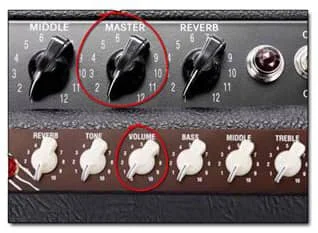
And the Volume control, which in some amplifiers is also called Gain, and is usually found right next to the guitar connection. The latter would be responsible for setting the Gain or Distortion of the Amplifier.
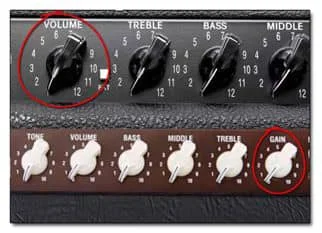
The Volume or Gain controls are responsible for the signal level entering the amplifier. So, with this control, we can saturate the amplifier if we allow enough signal to enter for this to happen. As a result, the amplifier would begin to distort the sound.
The master volume controls the signal coming out of the amplifier, raising the sound without adding gain or distortion. Consequently, it will increase the volume of the sound as it is, whether clean or distorted.
Setting Guitar Gain or Distortion
The Guitar Volume Control is another control used to setting the gain or distortion of the sound. This control is usually left at maximum so that a good signal reaches the amplifier. This way, we can achieve a clean sound if we lower the gain of the amplifier, and a distorted sound if we raise these controls.
The same would not happen if we had the volume of our guitar set at a low level. In this case, it would only allow us to obtain clean sounds, or it would make it very difficult to saturate the amplifier.
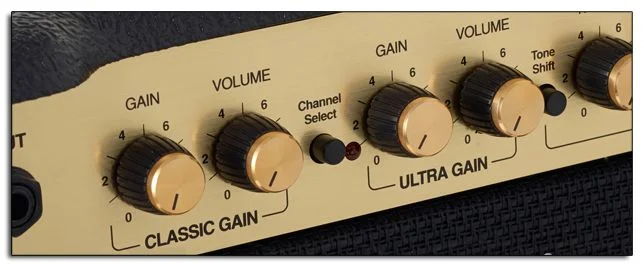
Clean Sound
If we want the cleanest sound possible, we need to adjust the volume of the guitar as low as possible. This will reduce the power of the signal coming out of our guitar, which has to be absorbed by the amplifier.
We do the same thing with the amplifier, but even more pronounced. We lower the volume below half its range and raise the master volume to our liking to increase the volume of the device without adding any gain or saturation to the sound.
Crunch Sound
For a crunchy or slightly distorted sound, we can turn the guitar volume up to the max to really squeeze all the gain out of the pickup. For example, with single-coil pickups, since this type of pickup does not usually have a high output.
This is a very interesting area in terms of the dynamic qualities of the sound. Our guitar sounds quite clean when we play the strings gently, with more pronounced distortion when we strum the strings harder.
If we use double pickups, which are usually more powerful than single coil pickups, the maximum volume may be excessive. But that would be a matter of personal taste, but in any case we can say that it would be at or near its maximum.
The amplifier’s volume control can be set to about halfway, or slightly above or below halfway. The master volume, as you know, is a matter of taste.
Distorted Sound
For distorted sounds, we turn the guitar volume up to the max, and the amplifier volume up to the max or almost to the max. This way, we can adjust the gain directly from the guitar volume control, softening the distortion when we turn this control down slightly.
In short, the pure volume control would be the amplifier’s master volume. And with the volume controls on the guitar and amplifier, we can manage the amount of saturation we want, or that the equipment allows us. This level of saturation is determined by the type of amplifier and the type of pickups on our guitar. The maximum distortion range would be provided by a high-gain amplifier and high-gain pickups.
Setting Guitar GAIN Using a Volume Pedal
As mentioned above, if we want to lower only the volume without altering the gain (distortion), we have to use the amplifier’s master volume. This would be very inconvenient, especially when playing live.
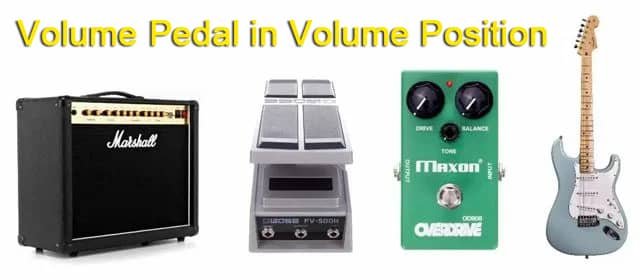
To solve this problem, we can use a volume pedal. But for it to behave like a master volume, this pedal would have to be placed after the gain or distortion pedals, right between the amplifier and the saturation pedals. This would maintain the predetermined gain ranges when the volume pedal is activated.
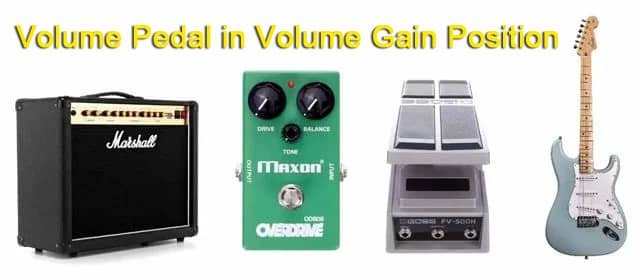
If we want to alter the gain levels by pressing the volume pedal, we would have to place it between the guitar and the distortion pedals. This way, it would act as a gain control, or as the guitar’s own volume control.
How to Setting Guitar and Amp Tone
Click on the image above to learn how to adjust the tone of your electric guitar and amplifier. Learn how to use the controls on your electric guitar and amplifier that are responsible for this function, and understand the influence of the room or venue and other instruments on the equalization.