
USE AND CHARACTERISTICS of Different Types of Electric Guitar Amplifiers: Tube, Hybrid, and Transistor Amplifiers. Pros and cons.
Depending on how the amplification stages of an electric guitar amplifier are manufactured, we can differentiate between three main types or groups of amplifiers: tube, hybrid and transistor amplifiers.
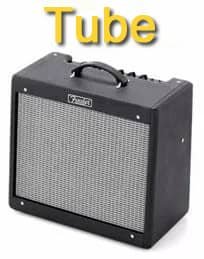
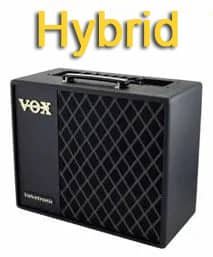
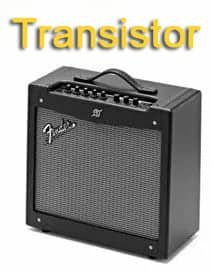
Types of Guitar Amplifiers: Tube
In tube amplifiers, both the preamplifier and power stages are constructed using vacuum tubes.
In transistor amplifiers, also called solid-state amplifiers, the stages would obviously be built with transistors.
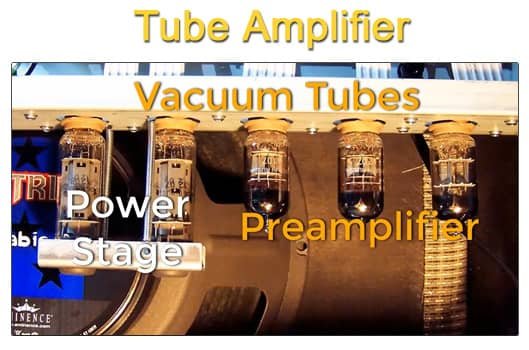
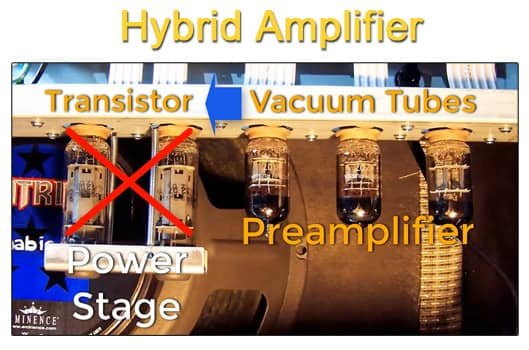
And in hybrid amplifiers, their amplification stages would be built using both vacuum tubes and transistors. Normally, valves are used for the preamp, and transistors for the power stage.
Hybrid Amplifiers
Hybrid amplifiers seek to combine the two previous types, offering a middle ground in terms of sound, price, and maintenance. The aim of these amplifiers is to achieve the natural tone of tube amplifiers, but with lower production costs and without the drawbacks of a tube power stage, such as having to replace valves from time to time and bias adjustment.
Types of Guitar Amplifiers: Transistor
Among the advantages of transistor amplifiers over tube amplifiers is their lower cost, both at the time of purchase and in terms of future maintenance. Transistor amplifiers do not require any maintenance, unlike tube amplifiers, which will eventually need to have their tubes replaced.
The convenience of a transistor amplifier is also a big advantage. They are lighter than other types of amplifiers, and you don’t have to wait for the device to warm up before you can start playing.
We can also move the transistor amplifier without any problems while it is hot. This is something we could not do with a tube amplifier. For a tube amplifier, it is advisable to connect it at least a couple of minutes before starting to play.

Waiting Times in Tube Amplifiers
When playing live, it is best to plug it in at least 15 minutes before starting. These devices perform best when you could fry an egg on top. Once the session is over, it is a good idea to wait 15 minutes before moving it, to give the valves time to cool down.
A solid-state amplifier is also more efficient in terms of power consumption. Tube amplifiers generate much more heat and consume more electricity. This can be problematic when playing in summer, in a small soundproofed room, which after a while turns into a real sauna.
Transistor amplifiers usually include amplifier simulations, lots of effects and presets, a tuner, and a headphone output. They tend to be all-in-one devices, unlike tube or hybrid amplifiers, which usually only include reverb effects and, in some cases, tremolo effects.
In addition, transistor amplifiers are more resistant to shocks than tube amplifiers. So if you need a rugged amplifier for home, studio, and rehearsal use that you can turn on, turn off, and move around at any time, a transistor amplifier is what you’re looking for.
On the other hand, a tube amplifier is more resistant than a transistorized one when it comes to turning up the volume and subjecting it to high demands. You could say that would be his natural state of comfort.
On the other hand, the transistor amplifier would be forced to operate at high volume levels, with the risk that some parts could be ejected.
Pure Valve: The King of Amplifiers
When it comes to sound, and within the same quality range as a transistor amplifier, the tube amplifier is king, both in clean sounds and in saturated or distorted sounds.
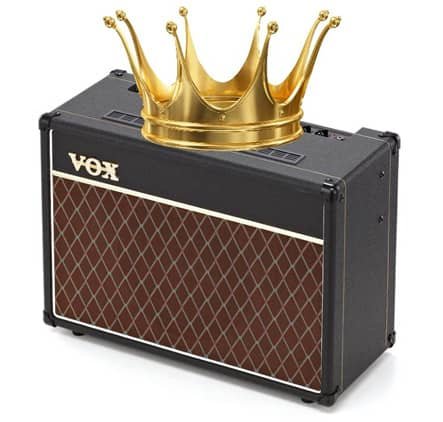
When it comes to clean sounds, the two are more evenly matched. It is in crunch or distorted sounds where the tube amplifier clearly stands out over the solid-state amplifier.
It offers a creamy, compressed and very intense distortion that is also pleasant. The purest, most authentic and professional electric guitar sound, used by the vast majority of guitarists. With a few exceptions, such as Dimebag Darrell, who used transistor amplifiers. But in the end, he ended up using tubes in his Krank Krankenstein amplifier, which he designed himself and used during his time with Damageplan.
Although digital units such as the Kemper Profiling Amp are very popular today, for those who need a wide variety of effects and amplifier simulations.
Power between Transistors and Tubes
Something we must take into account when purchasing an amplifier is its power. This is because the same power varies greatly in volume depending on whether the amplifier is transistor or tube.
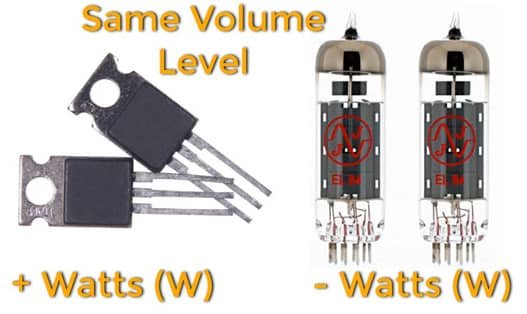
A 15W tube amplifier, although it may look small and seem insignificant, is actually a very powerful amplifier.
It would not be easy to give an exact figure for what that power would be equivalent to in a transistor amplifier, because the type of valves and the sensitivity of the loudspeaker can influence this. But it could be between 50 and 75 watts for transistors at a minimum.
Types of Guitar Amplifiers: Most Popular Brands
As for the most popular manufacturers of tube amplifiers, we have legendary brands such as Marshall, Orange, Blackstar, Vox, and Fender, among many others.
Although these same brands also develop amplifiers of all kinds, in order to offer their customers a wide variety of products.
As for hybrid amplifiers, the Vox combo models stand out, which can be found in the VT series, such as the Vox VT40X for a $400. And the small but powerful Orange heads developed in the micro series, such as the Micro Terror or the Micro Dark. What’s more, these amplifiers from the legendary brand are very reasonably priced at between $150 and $200.
As for transistor amplifiers, one of the highest rated is the Boss Katana 50, priced at around $350. However, there are also more affordable options available, such as the Line6 Spider V 30 MkII for around $250, or the Roland Cube-10GX for a mere $225.