
The Gibson Firebird traces its origins to the early 1960s, when renowned automotive designer Raymond Dietrich was commissioned by Gibson to design a new guitar model.
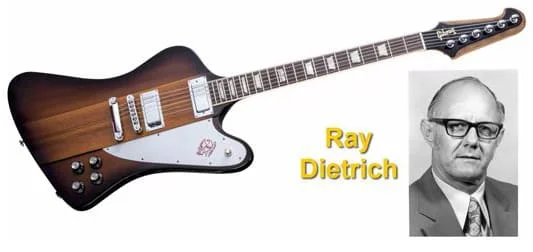
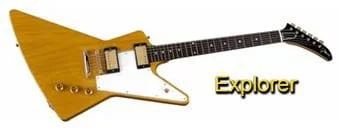
Dietrich drew inspiration from the distinctive quarter panels of 1950s cars and the lines of Gibson’s Explorer model to design the body of the new guitar. In a way, its shape resembles that of the Explorer model, but with softer, more rounded lines.
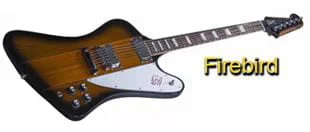
The new model was named the Firebird, or commonly known as the Reverse Firebird. Unlike the classic models, this guitar features the wider bulge on the lower part of the body, rather than on the upper part.
The headstock is also reverse-style with six tuners inline, unlike the traditional Gibson three-by-three tuning machine.
The headstock is shaped like a hawk’s head and features banjo-style tuning pegs so that the tuners wouldn’t obstruct the guitar’s visual line. The shape of this model is very reminiscent of an inverted Fender Jaguar or Jazzmaster. However, at their core, they are very different guitars. In fact, Fender believed that the Firebird’s design was a copy of its own models.
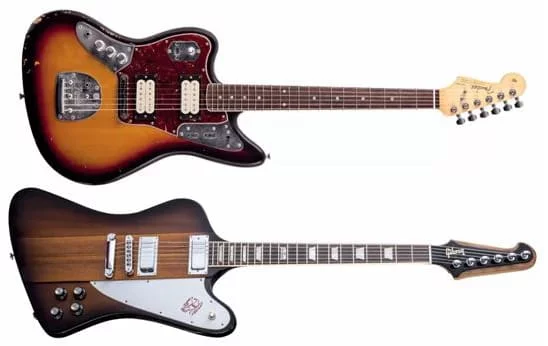
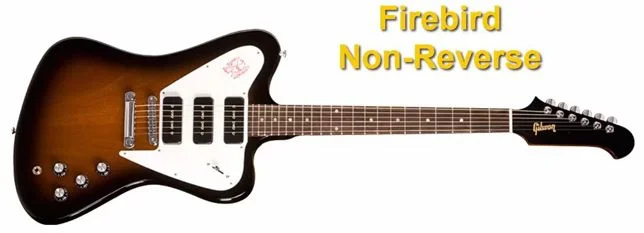
Gibson Firebird Non-Reverse
To avoid any potential legal disputes, the entire line was redesigned starting in 1966, and the Firebird was given a different shape; this model became known as the “non-reverse”. Ironically, the new design looked more like a Fender than the previous one.
Nevertheless, no legal disputes ultimately arose, as the differences are obvious, and both models are still in production today.
Gibson FIREBIRD: Neck-thru
One of the new features compared to earlier electric guitar models made by Gibson was its neck-through construction. In this design, the neck is an integral part of the guitar body, extending through it.
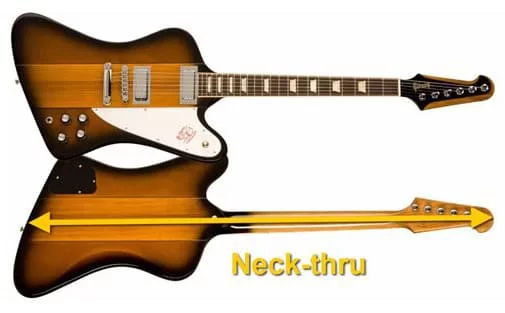
This design makes the instrument more expensive and complicates its manufacture, but it provides greater sustain and resonance, as well as creating a very smooth transition between the neck and the body of the guitar, which facilitates access to the lower part of the fretboard.
The neck is constructed from mahogany and walnut, with a rosewood fingerboard featuring a 12-inch radius, and the body is finished with two mahogany wings on either side of the neck extension, giving the guitar body its final shape.
Gibson Firebird: Bridge and Pickups
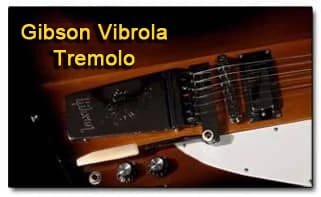
Gibson Vibrola Tremolo
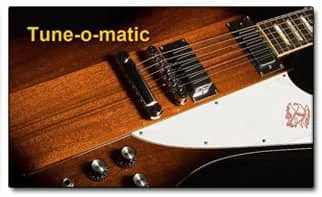
The classic Firebird model features a Gibson Vibrola Tremolo. although this guitar is now also available with the standard Gibson Tune-o-matic bridge.
This would be the most classic construction, but there are also some Firebird models with a set-in neck, particularly the ‘non-reverse’ models.
Firebird Pickups
The most distinctive new feature, and the one that had the greatest influence on the final sound of the new design, was its electromagnetic pickups. These are not the traditional humbucker pickups so characteristic of the Gibson brand.
The Firebird pickups are specially designed for this instrument and consist of a dual-coil system fitted with Alnico V magnets.
In fact, it is a mini-humbucker pickup model or type with two magnet bars, as can be seen in the image below, which shows a Firebird pickup without its metal cover.
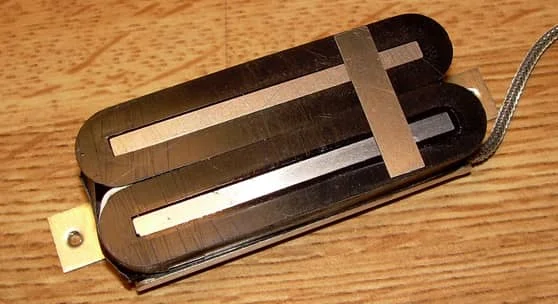
If we’re being strict about the technical details, their construction isn’t exactly the same as that of standard mini humbuckers with adjustable poles.
To distinguish the pickups on this Gibson model, they are simply known as Firebird pickups. But as mentioned, they are simply a distinct type of mini humbucker, based on a dual-coil system.
To make this point absolutely clear, even a major pickup brand such as Seymour Duncan describes its classic Firebird SM-1 model as a Mini Humbucker.
These pickups offer a brighter, more direct sound with a twangy tone reminiscent of Fender models, making them ideal for genres such as blues, rock and hard rock. You could say that the sound of Firebird pickups lies somewhere between a single-coil and a P90. In other words, the Gibson Firebird’s sound falls somewhere between that of a Gibson and that of a Rickenbacker.
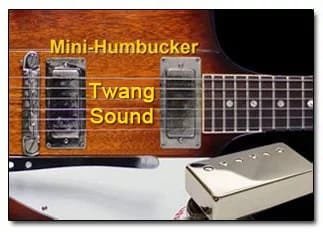
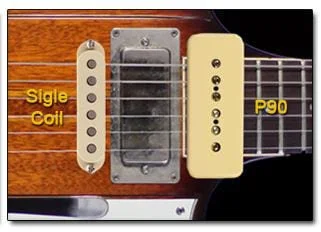
A true-blooded Firebird must be fitted with this type of pickup. However, we also have Firebird models with P90 pickups and traditional humbucker pickups. Although this would take us away from the purest Firebird style.
Gibson Firebird
The Gibson lineup includes classic models starting at $6,500. Some of the famous musicians who use or have used Firebirds include Tom Petty and the Heartbreakers, Johnny Winter, Joe Bonamassa, Gary Moore, and The Rolling Stones specifically Keith Richards, Brian Jones and Ron Wood.
Epiphone Firebird
The Epiphone brand is a good option if you’re looking for a Firebird at a reasonable price. You can find an Epiphone Firebird for around $800. This model features Firebird’s standard specifications, such as a mahogany body, a mahogany and walnut neck, and Mini-ProBucker FB720 pickups.
FIREBIRD: Alternatives
Guild Jetstar
Other brands offer some very interesting models, such as the Guild Jetstar. Many people will prefer the original, but believe me, this guitar is more ergonomic than the original.
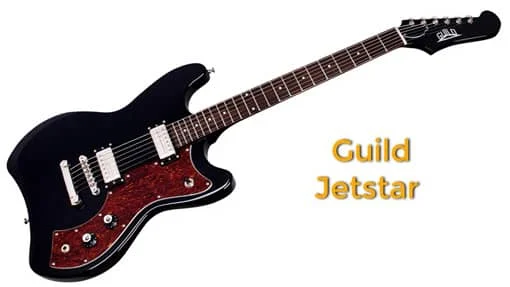
The sound of the Guild Jetstar obviously won’t be the same as that of a Gibson Firebird, but it can be considered to be in the same style. In any case, the Jetstar has an excellent sound, both clean and distorted.
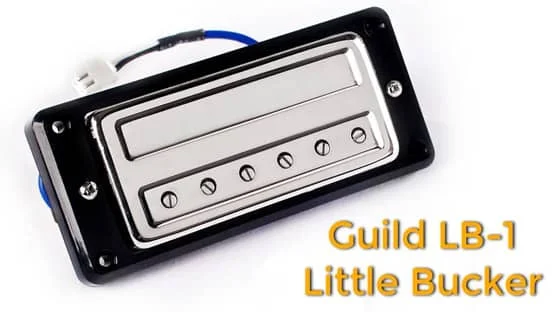
The Guild Jetstar features a set-in mahogany neck and body, and is fitted with Guild LB-1 pickups, priced at around $700. The letters ‘LB’ refer to the Little Bucker mini humbucker pickup, which features an Alnico V magnet.
Guild S-200 T-Bird
The Guild S-200 T-Bird follows the same guidelines as the previous model in terms of wood and pickup type, but the S-200 T-Bird features a few additional specifications.
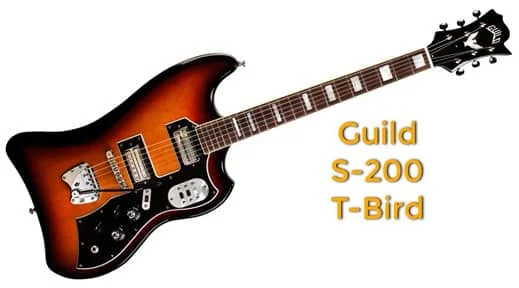
Featuring its Hagstrom Vintage Tremar tremolo bridge and dual-circuit design, with a rhythm mode that activates the neck pickup via individual volume and tone controls. Meanwhile, the solo mode can engage both pickups via its toggle switches. This circuit also features dedicated volume and tone controls, as well as a switchable tone filter.
A wonderful reissue from the late 1960s, one of Guild’s most distinctive and iconic models with a truly superb jazz, blues and rock sound, and manufactured in Korea at an affordable price of around $800.
For those who like unusual retro-style guitars, these could be two excellent choices, as these models boast a tremendously organic sound, full of life and character.
The Firebird is a rather bulky guitar, somewhat uncomfortable to play whilst seated; the first few frets are a bit far away, and it has a tendency to neck dive. So it takes a bit of time to get used to its ergonomics. Although it won’t take long before we’re amazed by its great, distinctive sound.